
Inside the Vasyugan Mire: history, legends, and a global carbon sink
Explore the Vasyugan Mire in Western Siberia—one of the world’s largest bogs. Uncover ancient cultures, Old Believer legends, and its role as a carbon sink.
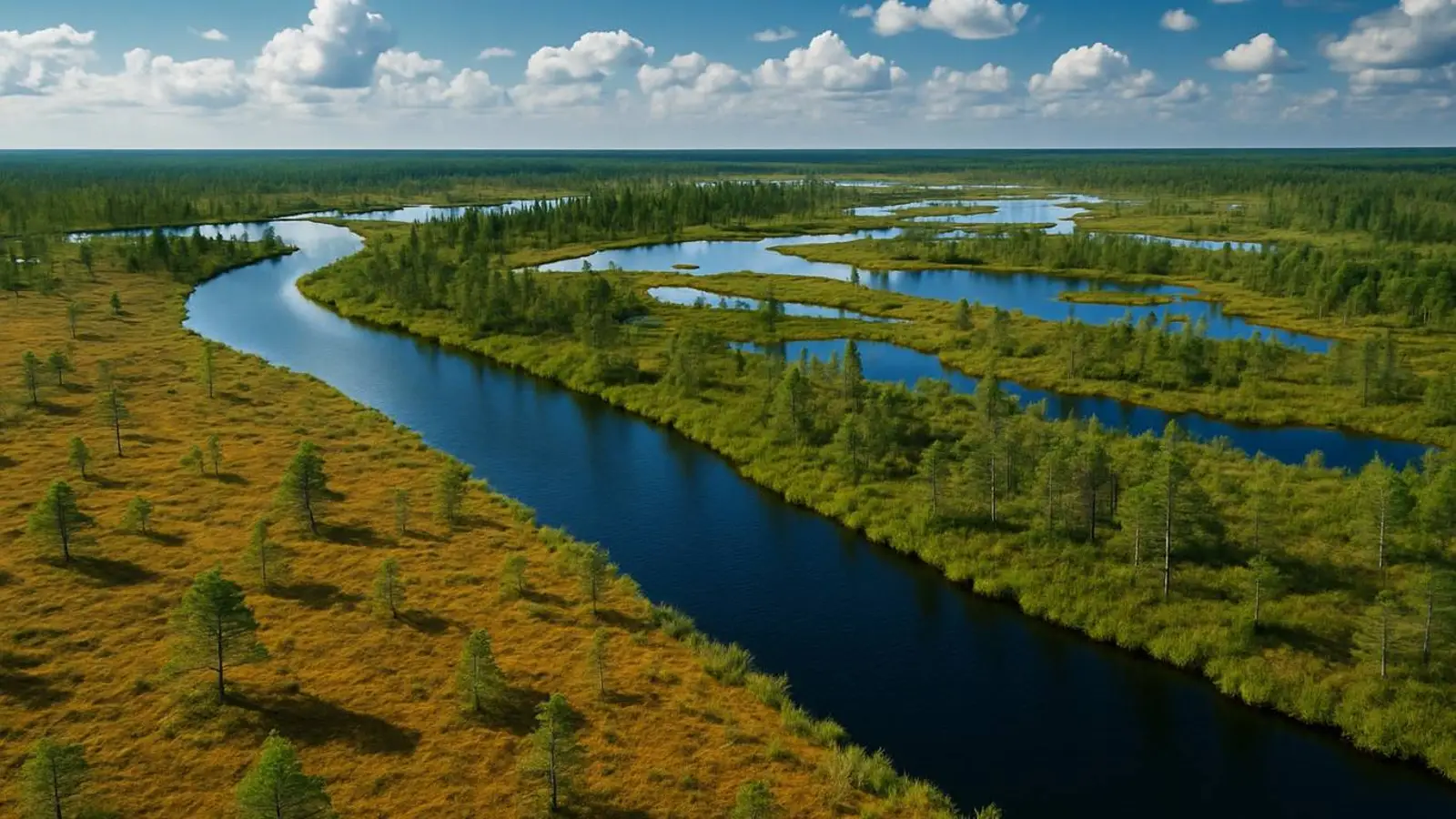
Generated by DALL·E
The Vasyugan Mire is one of Russia’s least explored corners. This vast stretch of Western Siberia has stayed hard to reach and almost uninhabited for centuries, and yet that quiet is exactly what draws scientific curiosity and keeps the legends alive.
A mire the size of a country
The Vasyugan wetlands run for almost a thousand kilometers, crossing parts of the Tomsk, Novosibirsk, and Omsk regions. They cover more than 53,000 square kilometers—larger than some European states. The bog took shape about ten thousand years ago and continues to expand. Over the last five centuries, its area has quadrupled. The terrain and climate create perfect conditions for peat to spread, steadily consuming everything around it. Where villages once stood, empty buildings are the only signs that people were ever there.
Life amid the mire
Despite the apparent emptiness, people settled here in antiquity. Communities linked to the Ust-Tartas, Odinovo, and Krotovo archaeological cultures lived in semi-dugouts and relied on hunting, herding, and fishing.
Archaeologists also found the so-called Vasyugan Masks—bronze pieces used in ritual practice. Researchers believe they adorned figurines representing the spirits of deceased relatives, with rites intended to shield the kin group from malevolent forces.
The search for Belovodye
In the early twentieth century, Old Believers came to the bogs seeking a place to hide from persecution and live by their traditions. Legends about Belovodye, a promised land, led them to Vasyuganye. They built houses, farmed, and cut trails through the mire. Over time, the settlements disappeared. By the 1980s, geologists were finding only abandoned hermitages—quiet remnants of a former life.
Bogs of the exiled
In the nineteenth and twentieth centuries, the Narym region, hemmed in by wetlands, became a place of exile. Thousands of revolutionaries served their sentences here. In 1912, Joseph Dzhugashvili, the future Stalin, arrived as well, though he soon escaped. Later, the authorities sent people labeled as kulaks and enemies of the people. The population multiplied several times, and many never left.
A natural refrigerator for the planet
The Vasyugan bogs play a significant role in the global climate system. They actively absorb carbon dioxide and lock carbon away for thousands of years. For comparison, grass holds it for about five years, and forest for roughly a century and a half. This peatland capacity helps cool the air and soften the greenhouse effect. In 2006, the area was designated a protected site, and in 2017 it became a nature reserve. That status made it possible to regulate economic activity and limit tourism.
Perilous paths
Seasoned travelers say bogs rarely forgive mistakes. Quagmires hide voids, and moving here without a guide is dangerous. If someone falls through, sphagnum can preserve the body—without decomposer bacteria, decay simply doesn’t occur. So far, no bog bodies have been found in Vasyugan—peat is not mined here—but the very possibility deepens the place’s mystique.
A territory of secrets
The Vasyugan Mire remains an enigma—vast, cold, and imposing. It holds traces of ancient cultures, the history of the exiled, and the hopes of those who went searching for paradise on earth. Here, the past and the landscape still set the rules, and the present steps lightly.