https://boda.su/en/posts/id3131-save-your-vhs-tapes-digitize-family-memories-today
Save your VHS tapes: digitize family memories today
Why VHS tapes decay and how to digitize them in time
Save your VHS tapes: digitize family memories today
VHS tapes degrade even on the shelf. Learn what causes decay, why old VCRs fail, and how digitizing family videos preserves memories with lasting quality.
2025-12-13T00:09:05+03:00
2025-12-13T00:09:05+03:00
2025-12-13T00:09:05+03:00
Closet shelves still hold neatly labeled tapes — “Coming home from the maternity ward,” “First New Year,” “Wedding.” Those recordings once felt timeless, but reality is far less romantic. VHS magnetic tape starts to break down from the inside—even when a cassette sits untouched for years.The issue isn’t playback or aging VCRs. The tape follows its own chemistry, and time is working against it.What happens to magnetic tapeEach cassette is built on a thin polyethylene terephthalate base coated with a magnetic layer. That fragile pairing carries the main risk.The binder ages. The adhesive that holds the layers dries out and crumbles, and the tape begins to delaminate.Moisture and temperature swings speed up the damage, especially in closets and chilly overhead storage.Dust and fine debris get inside the shell and scratch the surface as the tape moves.Infrequent use doesn’t save it. On the contrary, the longer the tape lies still, the higher the chance of separation and shedding.The recording doesn’t vanish at once—but sooner or later a VCR won’t be able to read the picture.When the hardware gives outEven if a cassette looks fine, old VCRs need care. Belts stretch, rollers dry out, heads get dirty. The result is stutter, noise, or a refusal to play. Workshops that can service such devices are getting harder to find, and a fully working deck has become a rarity.The only reliable route is digitizationTo preserve family archives and one-of-a-kind videos, specialists advise not to wait until there’s nothing left to recover. Digitization moves the image into a modern format and lets you store it on a computer, a flash drive, or in the cloud.The benefits are clear:The recording no longer degrades.You can send and duplicate copies without quality loss.You can treat the audio, improve the picture, and reduce noise.As for old films and cartoons still kept on VHS, it’s simpler to buy them in good digital quality—the image will be much easier on the eyes.Time erases, but memory can be savedVideotapes are part of a sweeping technological era that’s slowly fading. Personal stories shouldn’t disappear with it. Decades on a shelf don’t make recordings stronger—they only bring closer the moment the tape gives out.If your home still holds cassettes tied to important family moments, delaying is a gamble. Digitization turns fragile tape into a stable digital archive you can keep indefinitely. Where VHS loses ground, memory endures. The important thing is to save it in time.
VHS tapes, digitization, convert VHS to digital, preserve family memories, VHS degradation, VCR problems, transfer videotapes, home archives, video restoration, cloud storage, family videos
2025
articles
Why VHS tapes decay and how to digitize them in time
VHS tapes degrade even on the shelf. Learn what causes decay, why old VCRs fail, and how digitizing family videos preserves memories with lasting quality.
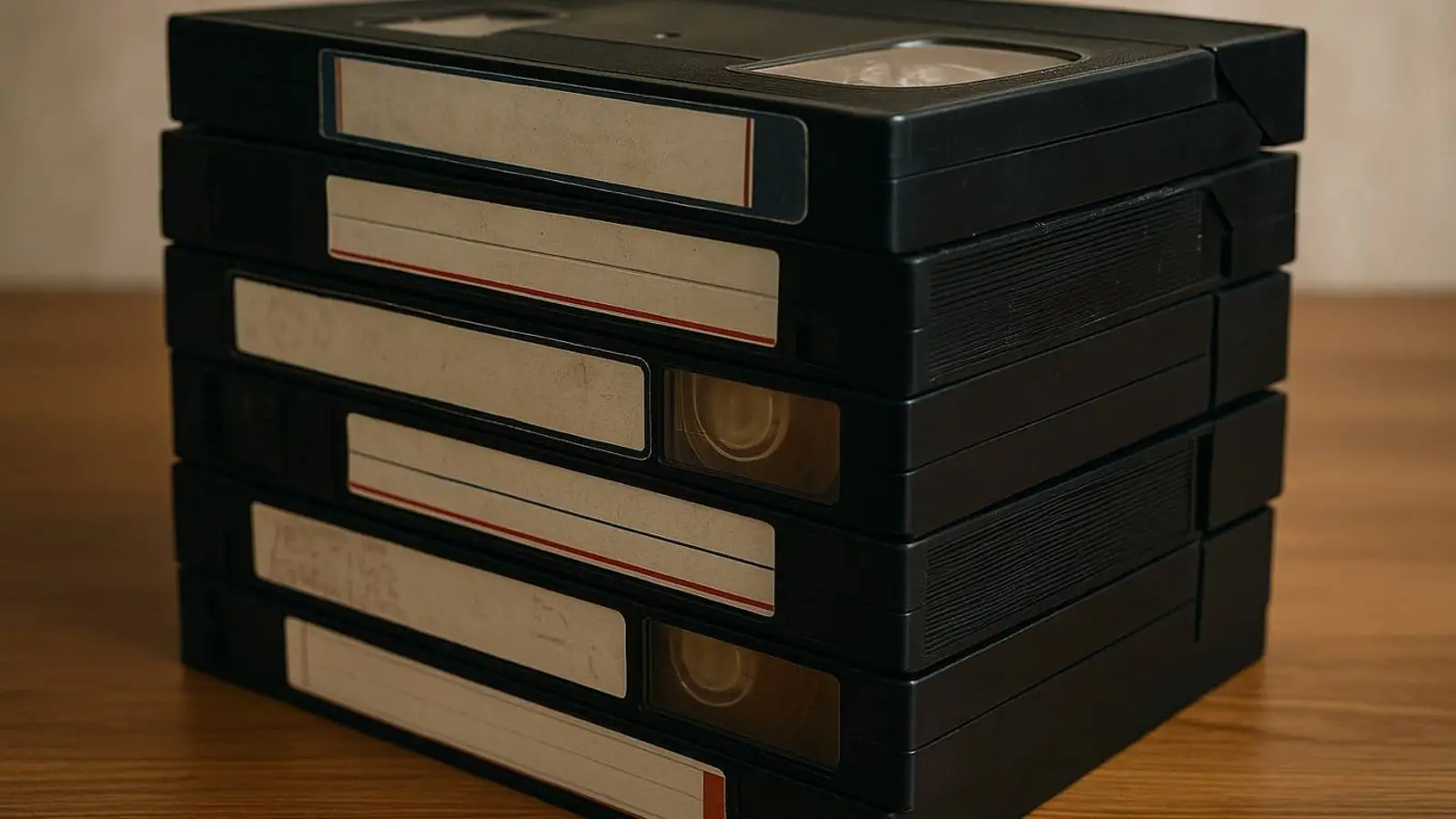
Generated by DALL·E
Closet shelves still hold neatly labeled tapes — “Coming home from the maternity ward,” “First New Year,” “Wedding.” Those recordings once felt timeless, but reality is far less romantic. VHS magnetic tape starts to break down from the inside—even when a cassette sits untouched for years.
The issue isn’t playback or aging VCRs. The tape follows its own chemistry, and time is working against it.
What happens to magnetic tape
Each cassette is built on a thin polyethylene terephthalate base coated with a magnetic layer. That fragile pairing carries the main risk.
- The binder ages. The adhesive that holds the layers dries out and crumbles, and the tape begins to delaminate.
- Moisture and temperature swings speed up the damage, especially in closets and chilly overhead storage.
- Dust and fine debris get inside the shell and scratch the surface as the tape moves.
- Infrequent use doesn’t save it. On the contrary, the longer the tape lies still, the higher the chance of separation and shedding.
- The recording doesn’t vanish at once—but sooner or later a VCR won’t be able to read the picture.
When the hardware gives out
Even if a cassette looks fine, old VCRs need care. Belts stretch, rollers dry out, heads get dirty. The result is stutter, noise, or a refusal to play. Workshops that can service such devices are getting harder to find, and a fully working deck has become a rarity.
The only reliable route is digitization
To preserve family archives and one-of-a-kind videos, specialists advise not to wait until there’s nothing left to recover. Digitization moves the image into a modern format and lets you store it on a computer, a flash drive, or in the cloud.
The benefits are clear:
- The recording no longer degrades.
- You can send and duplicate copies without quality loss.
- You can treat the audio, improve the picture, and reduce noise.
As for old films and cartoons still kept on VHS, it’s simpler to buy them in good digital quality—the image will be much easier on the eyes.
Time erases, but memory can be saved
Videotapes are part of a sweeping technological era that’s slowly fading. Personal stories shouldn’t disappear with it. Decades on a shelf don’t make recordings stronger—they only bring closer the moment the tape gives out.
If your home still holds cassettes tied to important family moments, delaying is a gamble. Digitization turns fragile tape into a stable digital archive you can keep indefinitely. Where VHS loses ground, memory endures. The important thing is to save it in time.