
Inside Antarctica's McMurdo Dry Valleys: a Mars-like desert
Explore Antarctica's McMurdo Dry Valleys, an ultra-arid, Mars-like desert shaped by katabatic winds. Discover extremophiles, Lake Don Juan, and mummified seals.
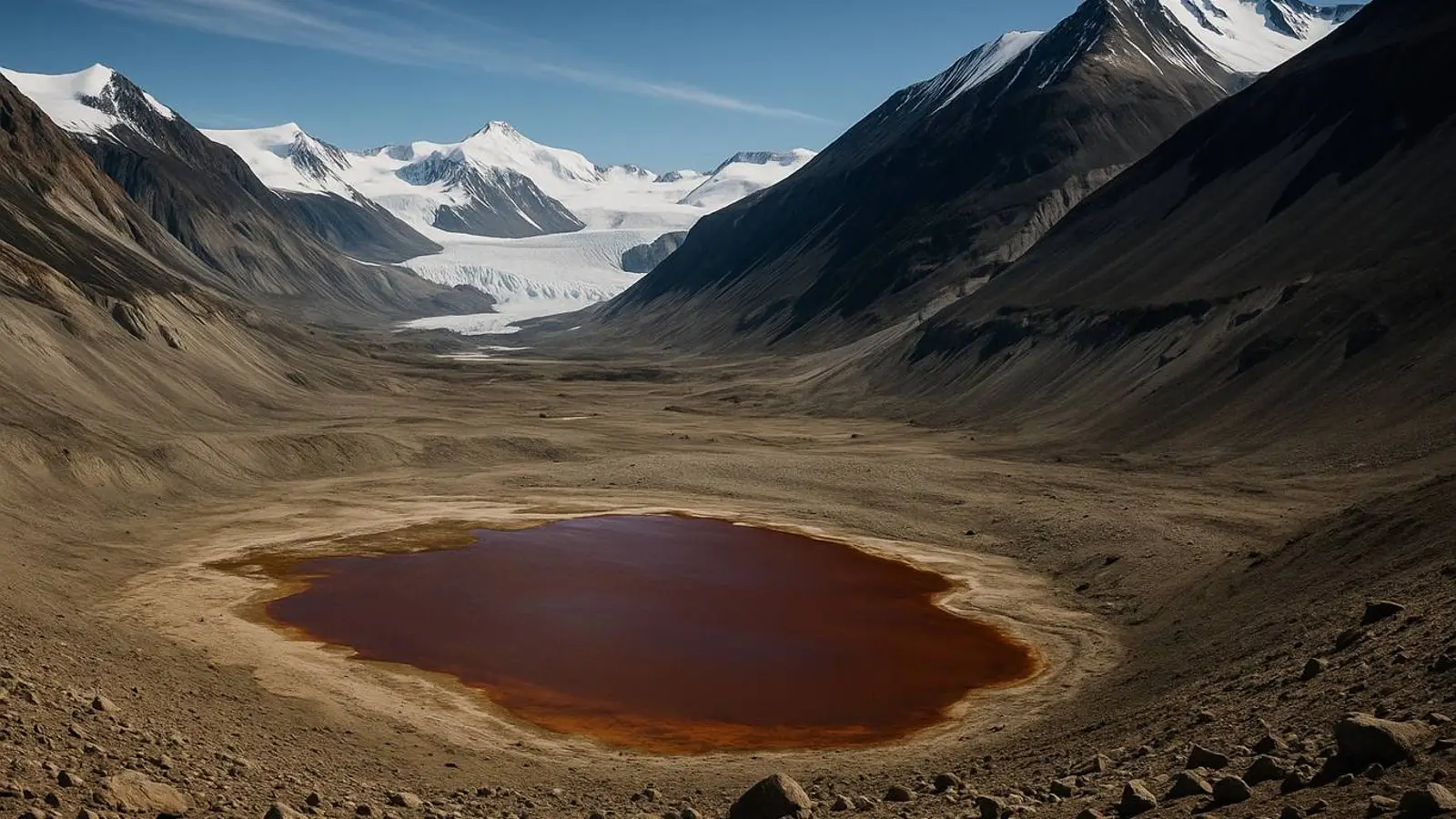
Generated by DALL·E
Among the world’s many deserts, one of the strangest hides in a realm of ice and cold. In a place where towering snowdrifts would seem inevitable, not a drop of precipitation has fallen for about two million years. This is the McMurdo Dry Valleys—lands that brush up against glaciers yet remain utterly devoid of moisture.
A zone beyond the reach of ice
The Dry Valleys are three large basins—Victoria, Wright, and Taylor—set near the Ross Sea, just a few dozen kilometers from the coast. Despite the ocean’s proximity, the landscape feels otherworldly. The Transantarctic Mountains form a natural barricade against glaciers, but the real architect of this aridity is the force of katabatic winds.
Cold air rushes down from the high plateau, accelerating to hurricane-like speeds. It sweeps away any hint of snow, while the rare frost crystals sublimate before they can touch the ground. The wind scours the surface so thoroughly that it looks like a field of stony regolith.
A paradox at the heart of an icebound continent
Antarctica holds most of the planet’s fresh water, yet here, in the heart of the ice sheet, precipitation is almost nonexistent. The annual moisture level is minimal. Persistent evaporation and relentless air movement keep the valleys dry even during periods of relative warming.
NASA research indicates that some areas have seen no precipitation for around two million years, a conclusion supported by isotope analysis and radiocarbon dating.
Mars at the end of the Earth
Because of these extremes, the Dry Valleys have become a natural testbed for space exploration. In the 1970s, NASA used the region as an analog for the Martian surface, trialing early rover prototypes and refining autonomous driving algorithms. Dusty soils, intense ultraviolet radiation, and the absence of organic material create ideal conditions for such trials.
Even more compelling is the search for life. Scientists study extremophile communities to assess whether microorganisms can survive in environments that mirror Martian conditions.
A world beneath the stones
There are no animals here, and no plants. Yet in rock fissures and beneath stones, researchers have found microorganisms capable of enduring for centuries without active metabolism. Some bacteria shelter inside minerals, drawing on traces of moisture and chemical energy. Their cell division is extraordinarily slow—on the order of once every thousand years. Findings like these stretch our understanding of life’s limits on Earth.
Lakes that shouldn’t exist here
Despite the extreme dryness, several lakes lie within the valleys. Their waters are relics, preserved since ancient glaciations. One of the most unusual is Lake Don Juan, whose salinity is so high that it remains liquid even when temperatures drop below −50 °C.
Researchers have discovered microorganisms there that use perchlorates as an energy source—compounds that are almost certainly present on Mars as well.
Mummies that outlast millennia
The dryness of the valleys has a remarkable side effect: it preserves organic matter. In one ravine, scientists found a seal mummy almost perfectly intact, likely an animal that lost its way and died many centuries ago. Cold and wind desiccated the carcass, stopping decay entirely. In a similar fashion, an ancient elephant seal mummy more than 2,500 years old was found in 2018.
A place almost no one reaches
The McMurdo Dry Valleys are among the most inaccessible places on the planet. International agreements regulate entry, and access is limited to research teams. The environment is exceptionally fragile: a single step off an approved route can destroy a microbial colony that took thousands of years to form.
That is why the Dry Valleys endure as a rare fragment of untouched nature—free of human footprints and beyond the reach of civilization.