
How to plan a distribution board and balance home loads
Plan a distribution board, balance three‑phase and single‑phase loads, and wire kitchens and bathrooms safely. Practical tips on boilers, convectors, breakers.
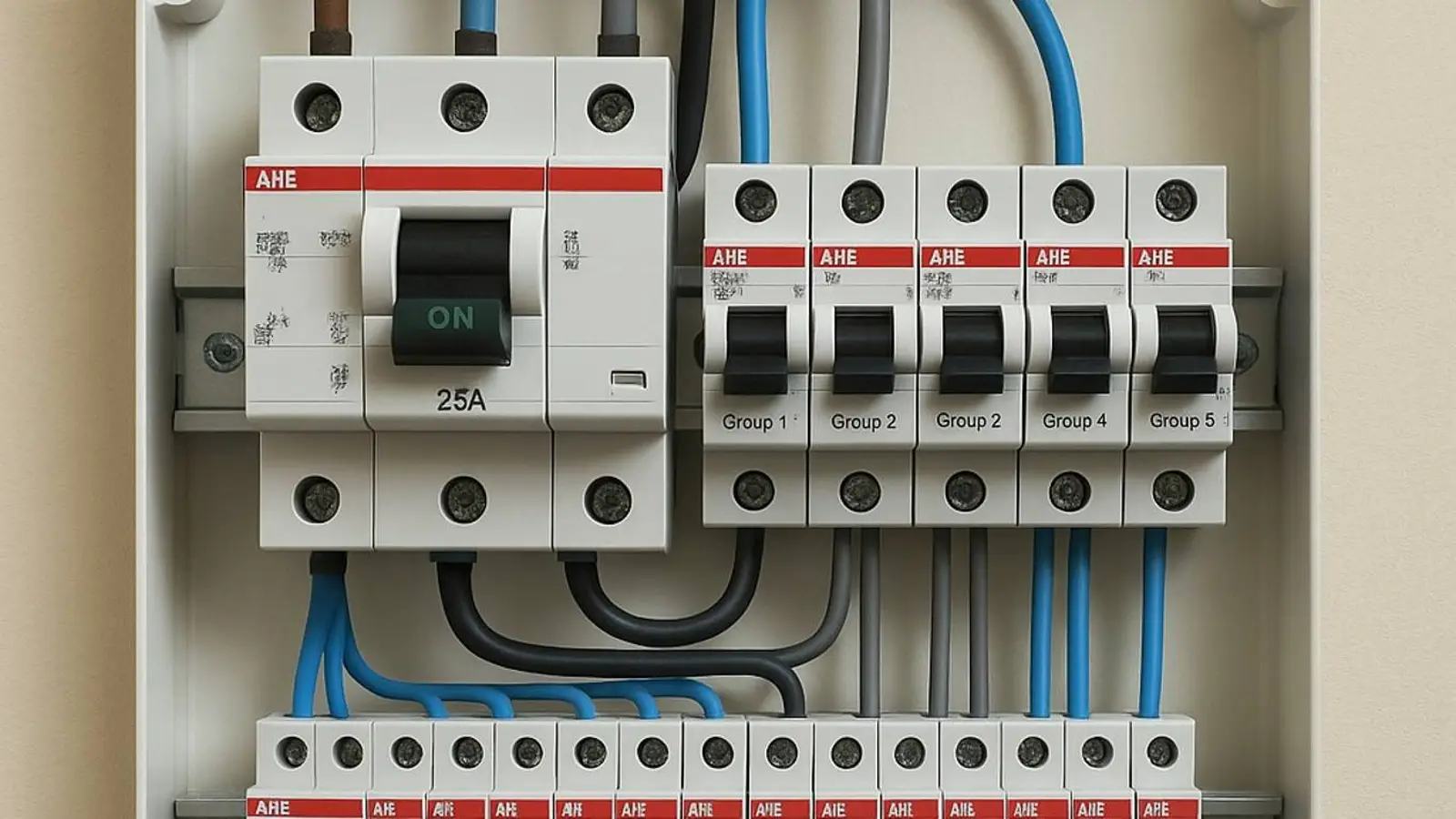
Generated by DALL·E
A well-organized distribution board is the backbone of a stable electrical system. How circuits are grouped and how demand is spread across phases affects not only convenience but also safety. A mistake at this stage easily leads to overloads, shutoffs, and premature wear of equipment. The task is tougher in detached houses: a three-phase connection calls for thoughtful power allocation. Apartments are simpler, yet the kitchen and bathroom remain the usual high‑demand zones.
Which appliances need special attention
Every electrical device has a rated power. Cooktops, ovens, convectors, and water heaters all place a substantial burden on the system. Patterns of use matter too: not everything runs simultaneously.
When drafting the project, a utilization factor is applied. It helps estimate the real load that arises under normal day‑to‑day operation.
Detached houses: working with a three‑phase supply
For private homes, the most common setup remains a three‑phase 380 V connection with a total capacity of 15 kW. A 25 A main breaker allows roughly 5 kW per phase. Heating comes first. If an electric boiler is installed, it is almost always three‑phase. Inside are three heating elements connected in a star configuration, which evens out the load.
In practice, boilers around 8 kW run almost continuously in winter. That means a significant share of each phase is already occupied. The rest of the appliances have to be assigned carefully, with an eye to what is likely to run at the same time.
A few simple rules for the home:
- put the cooktop and the kettle on different phases;
- avoid placing the washing machine and the dishwasher on the same phase;
- connect the oven and the cooktop separately.
Even with moderate use, the 15 kW limit is quickly pushed to its ceiling. In homes with a single‑phase 7 kW connection, getting by without an additional heat source is practically impossible.
Convectors instead of a boiler: a different approach
If heating is spread across rooms via convectors, the load tends to smooth out. These units switch on as needed rather than all at once, which in practice lowers the risk of overloads. Small convectors of 0.5–1 kW can be tied into existing outlet circuits if installation rules are observed. The second floor often needs less power, as heat naturally rises. This setup offers flexible control and suits homes with limited available capacity.
Apartments: a single‑phase supply and its nuances
Modern apartments typically use a single‑phase supply rated at 10 or 13 kW. The key task is to group circuits sensibly and dedicate separate lines to high‑power appliances.
Main guidelines for apartments:
Outlet circuits
Each room should have its own circuit. Runs can be daisy‑chained or laid out as a radial via a junction box. The latter reduces the number of weak connections.
Lighting
The load is minimal, so a single line is acceptable, or separate lines by room. Use 1.5–2.5 mm² cables and 6–20 A breakers.
Bathroom
The washing machine, drying cabinet, and water heater all require dedicated lines. For instantaneous water heaters from 5 kW, use 4 mm² cable.
Kitchen
The most power‑hungry zone. For the oven and cooktop, use 6 mm² cable or two independent 4 mm² lines. Each outlet along the backsplash should be on its own circuit. This keeps connections stable when several devices run at once.
Planning is the main safety tool
Smart load distribution starts with something simple: knowing appliance power ratings and your actual usage habits. In a house, account for the boiler and balance the phases. In an apartment, set aside dedicated lines for the kitchen and bathroom and avoid unnecessary connections.
When the layout is planned in advance, the electrical system runs steadily and the risk of accidents drops to a minimum. For anyone mapping out an electrical project, these pointers serve as a practical guide.