
Mount Elbrus unveiled: 13 facts, legends, ascents, and risks
Discover 13 facts about Mount Elbrus: an active volcano, daring ascents, ancient legends, safety risks, and the debate over Europe’s highest peak today.
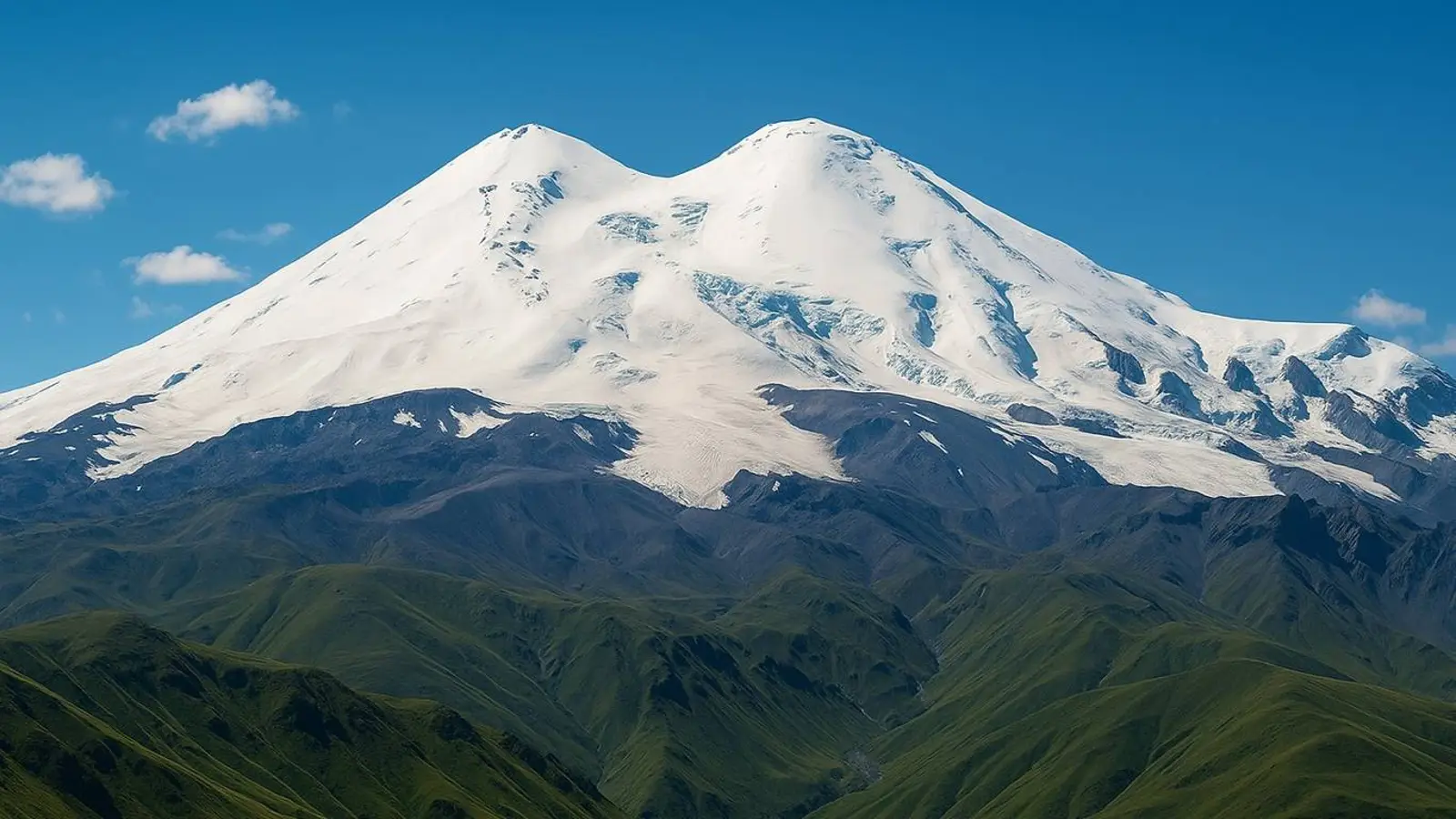
Generated by DALL·E
Mount Elbrus remains one of Russia’s most enigmatic peaks. Legends cling to it, scholars argue over it, and mountaineers keep testing themselves on its slopes. A baker’s dozen of facts offers a fresh angle on this mountain giant.
A volcano that slumbers
Elbrus is classed as an active volcano, even if it is calm today. Researchers believe the last major eruption happened about nine centuries ago, yet the possibility of reawakening persists. Specialists caution that the real danger is not molten lava but ice: glaciers can melt rapidly and turn into powerful torrents that rush down into the Baksan and Kuban river valleys.
A panorama reaching the Black Sea
In clear weather, the horizon from the summit can stretch all the way to the Black Sea. Such visibility is far from guaranteed, though — conditions at altitude shift by the minute, which makes the photos of those who catch that rare clarity all the more striking.
A changeable temper
Summer brings steadier weather here, so most ascents are planned for July and August. Winter is a different story: fierce winds, deep cold and avalanche risk make the climb extremely dangerous.
Unusual ascents
Local lore names the Balkar shepherd Akhiya Sottaev as the first to conquer Elbrus. The story goes that he summited nine times and last did so at the age of 121. The official history of ascents begins in 1829, when an expedition led by General Georgy Emmanuel reached the eastern summit. Later, people tackled Elbrus on a motorcycle, in a car, carrying a heavy barbell, and even on Karachay horses.
Prometheus’s trace
In ancient Greek myth, it was here, on Elbrus, that an eagle tormented the chained Prometheus. Similar legends appear in the folklore of Caucasus peoples, echoing the same rugged setting.
Mobile signal at altitude
In 2018, the highest-elevation base station in Russia and Eastern Europe was installed on Elbrus. Thanks to it, stable mobile internet works not only along the routes but also in mountaineering camps — up to the summit.
In search of Shambhala
The Elbrus region is tied to a legend about an entrance to the mysterious Shambhala. The tale proved so persistent that during World War II it drew the attention of members of the Ahnenerbe. No evidence was found, yet stories about special places continue to surface.
The cost of a mistake
Every year, around two dozen people die while attempting Elbrus. Experts note that many underestimate both the complexity of the route and the harsh reality of a 5,000‑meter peak.
The story of Priyut 11
At 4,100 meters once stood the highest-elevation hotel in the USSR, known as Priyut 11. It burned down in 1998, and ideas about rebuilding it are still discussed. The name dates back to 1909, when a group of schoolchildren camped there and left a playful inscription on the rock. A hut went up later, and eventually a full-fledged shelter.
An airfield above the clouds
During World War II, a plateau at roughly 2,800 meters served as a site used by German pilots. The place still attracts legends — and debate that refuses to die down.
A notional border between two continents
Elbrus is often called the watershed of Europe and Asia. Three major rivers — the Baksan, the Kuban and the Malka — rise here. The formal continental boundary remains a matter of scholarly dispute, but the idea underscores the mountain’s distinctive position.
The highest point in Europe?
Elbrus’s status as Europe’s highest depends on where the continental border is drawn. If one follows the Kumo–Manych Depression, the summit ends up in Asia and Mont Blanc takes the crown. If the border runs along the Main Caucasus Range, Elbrus remains Europe’s top point.
Mukha the fox — mistress of the slope
Elbrus even has a mascot: a fox named Mukha. A few years ago she grew accustomed to visiting the Gara-Bashi station, where cable car workers and tourists fed her. Mukha became a local celebrity, and her likeness found its way onto souvenirs — a small, endearing emblem of a formidable mountain.